I’ve got the Power!
The power supply requires some consideration. Neopixels typically have a maximum output power of 0.24W per LED (at 5V). All told I’ve got 150 LEDs, so that’s a total potential output of 150 × 0.24W = 36W, plus whatever’s required for the Pico but frankly that’ll be so minimal by comparison it’s not worth worrying about.
At 5V that’s 36W ÷ 5V = 7.2A which is way beyond the maximum output of the typical micro-USB power supply used with Picos; these often top out at 1A or 2A.
We need something quite a bit bigger, and preferably with a decent amount of overhead [1]. I’ll be using an 5V 100W supply which gives me 64W of head-room, but I’d guesstimate that anything 50W+ should be sufficient.
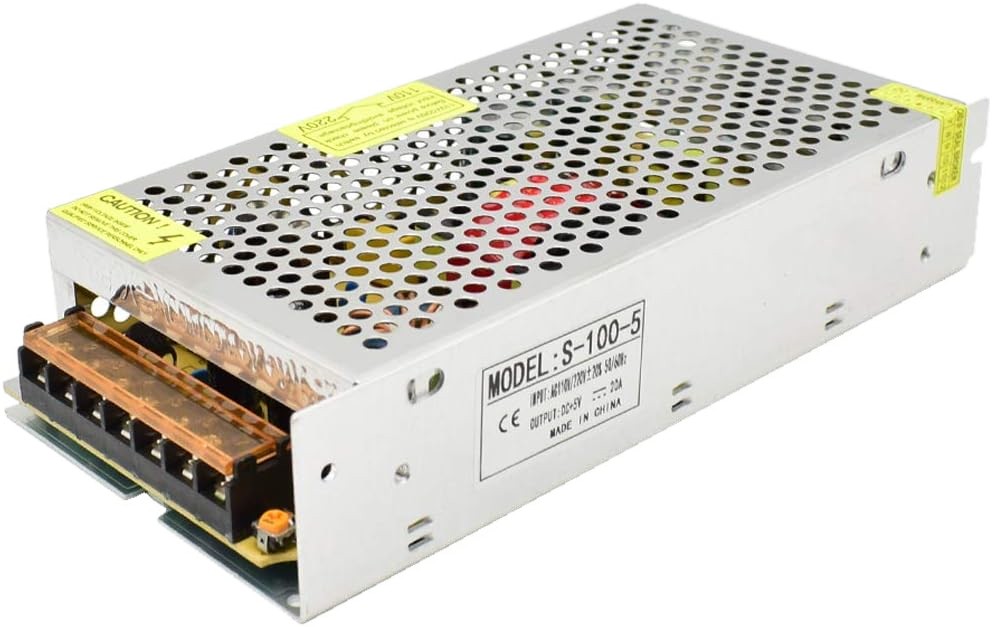
Warning
Please note that most of these supplies do not come with mains cables. This is why I included “being comfortable with wiring mains cables to a power supply” in the skills list at the top. You will need to be confident that you know which leads are live, neutral, and ground, when wiring this thing up.
The Heat Is On
Another thing to consider is heat in your wiring. The mains leads should be fine. At 240V, 100W is barely anything in amps: 100W ÷ 240V = 0.24A. However, consider the 5V side of things.
We’ve already calculated we’ll be pushing 7.2A through our wiring. Now the individual LED strips themselves will only be taking what they need, so the 100-LED strip will take 4.8A (⅔ of 7.2A) and the 50-LED strip will take 2.4A (⅓ of 7.2A). However, the 5V wire running from the power supply will be carrying the full 7.2A. With typical 24AWG solid-core wire that’s okay.
But let me caution you on the hazards of scaling this up without thinking about this! The first year I got this working, I used 150 LEDs, as we are in this tutorial. The next year, I scaled it up to 250 LEDs thinking “there’s more than enough headroom in the power supply”, but not considering the heating situation on the 5V side of things. 250 × 0.24W = 60W. 60W ÷ 5V = 12A. Pushing 12A through 24:term:AWG cable causes things to get hot:
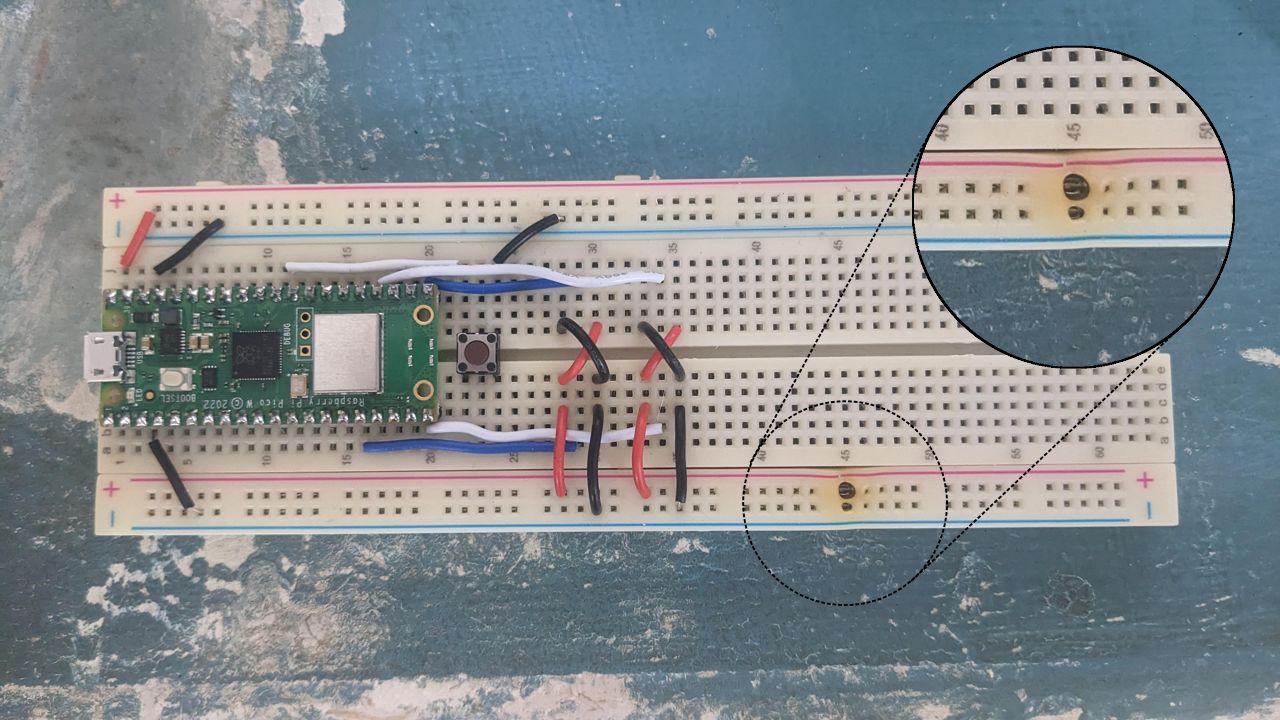
You can clearly see where I’d connected 5V from the power supply to the breadboard … it’s that melted hole on the bottom positive rail! I only noticed this after taking everything apart after the holidays, and then realized (given all this was housed rather carelessly in a spare cardboard box) just how close I’d come to setting fire to the tree!
The moral of the story is: if you’re planning to scale this beyond 150 LEDs, please take the time to calculate how much ampage you’re going to push through your 5V wiring. If necessary, split the load across multiple supplies (most of these supplies have multiple outputs), or get thicker gauge wire. And maybe stick all this in a non-flammable box!